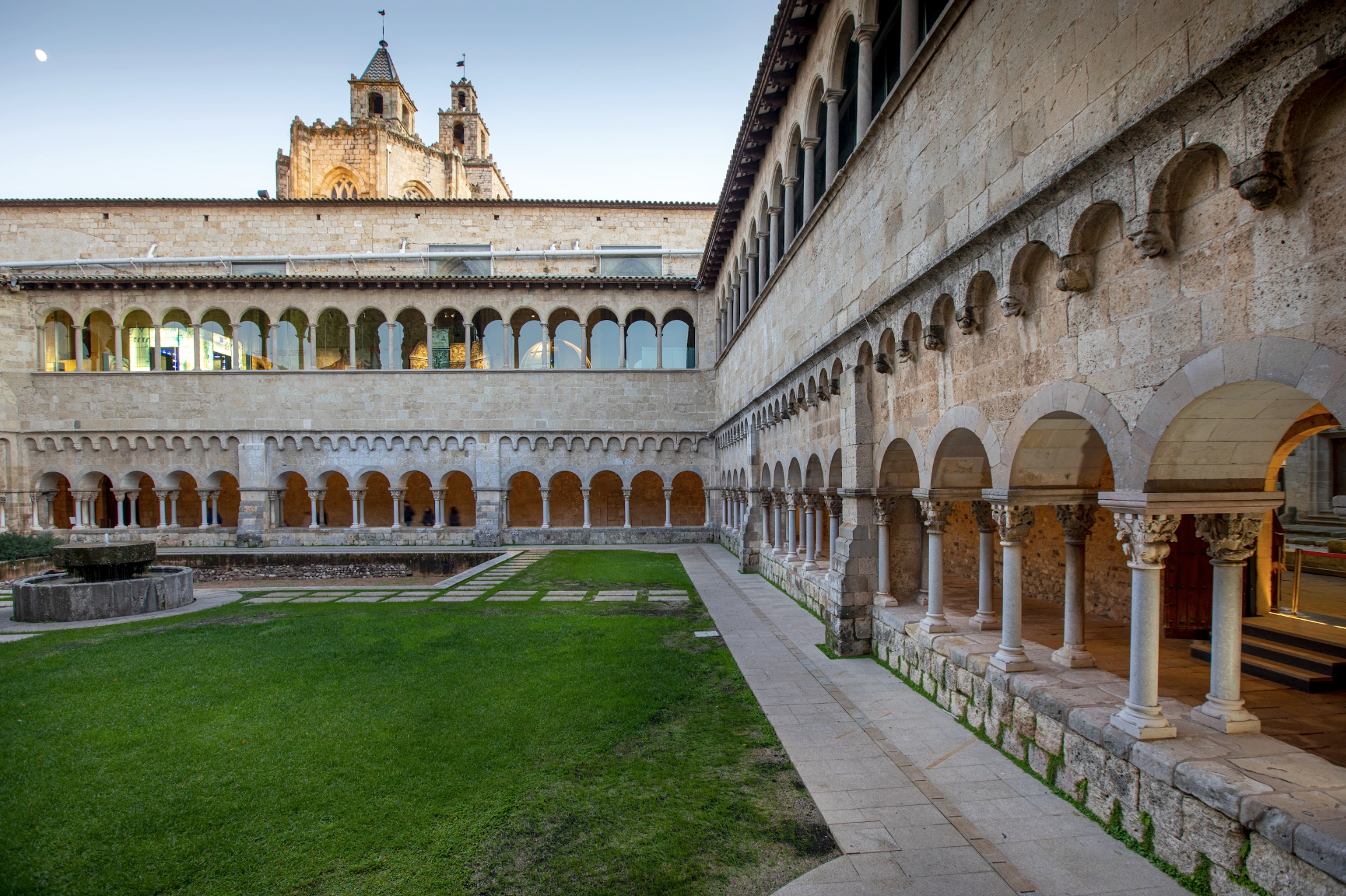
The Monestir de Sant Cugat is an ancient fortified Benedictine abbey in the heart of the town, just a few minutes from Barcelona. This complex of stone and silence brings together architectural styles from the pre-Romanesque to the Renaissance. Its 12th-century Romanesque cloister, with 144 capitals featuring a wealth of biblical scenes, symbols and human gestures, is a masterpiece of medieval sculpture. The church, with its basilica layout and three naves, uses light to narrate the transition from Romanesque to Gothic, culminating in a façade crowned by a rose window opening to the sky. It is a living heritage where silence itself tells a story.
This is good to know

The cloister of Sant Cugat is regarded as one of Europe’s finest, both for the number of its capitals and the narrative expressiveness of its sculptures.
The Gothic rose window on the main façade, inspired by Notre-Dame de Paris, casts a shifting light that marks the liturgical hours.
The church traces the architectural evolution from pre-Romanesque to Renaissance within a harmonious and unique space.
The site stands atop an ancient Roman castrum and a Paleochristian cemetery. Today, it houses a museum and is recognised as a Cultural Asset of National Interest.


