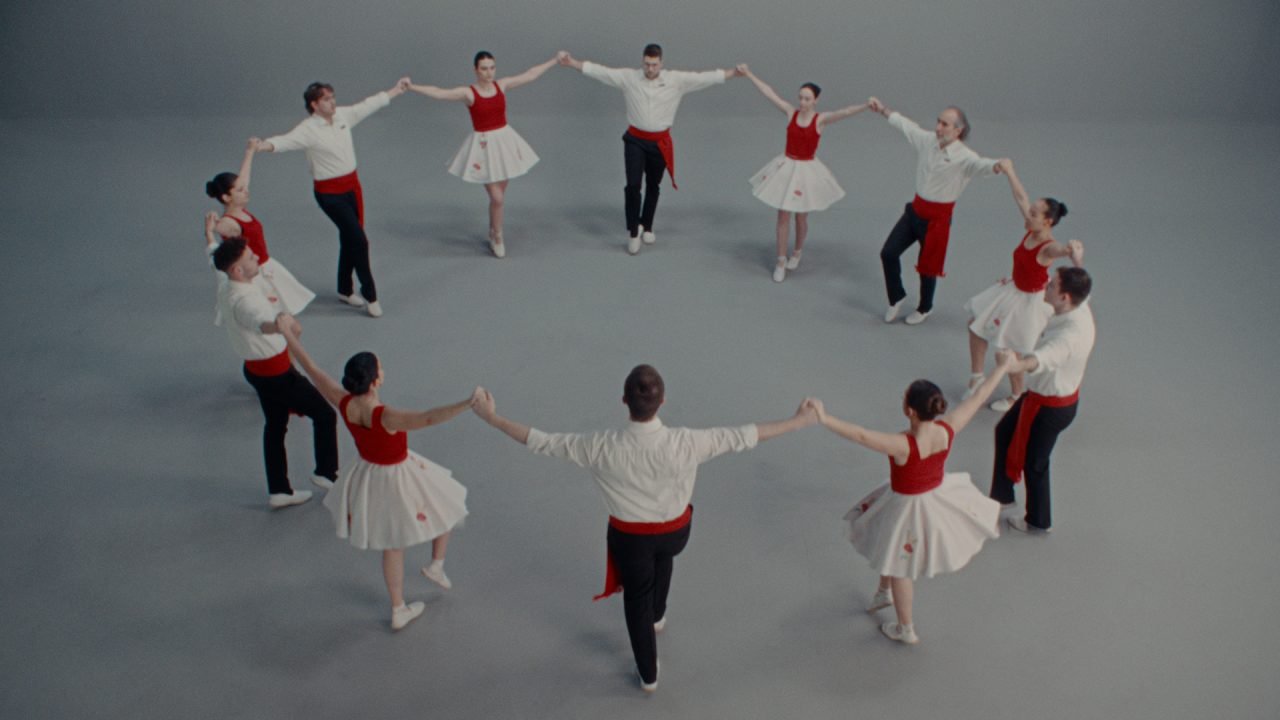
A dance that brings people together. There are no distinctions of class, gender or background, no need for particular skill or stamina, and just one condition: the willingness to be part of Catalan identity. That is the sardana, open to everyone and for everyone, yet closely tied to local identity, a perfectly balanced form, ready to welcome anyone who steps into the circle.


At its heart is the rotllana (the circle formed by the dancers). From there, everything moves to a rhythm that is much more than a sequence of steps. It is also a musical tradition in its own right, with thousands of pieces written for the cobla, the traditional Catalan ensemble, which includes two instruments rarely heard elsewhere: the tible and the tenora.
Each sardana is made up of curts and llargs (short and long sections). What looks like a straightforward two-step pattern hides one of its more complex elements: the repartiment, a precise counting of steps and timing so that everyone finishes together, in the same place, on the same foot, without breaking the circle. So yes, a bit of maths helps. If the timing is off, it does not quite count as a proper finish.
Then there is the aplec sardanista (sardana gathering), where things stretch further: not just a couple of dances, but hours of continuous movement that demand focus, rhythm and stamina. After that, even Zumba feels like a sideshow.


Some even dare to call it a revolutionary dance. Whether or not it ever played such a prominent role, we now know it went on to become a collective symbol.
A dance that changed everything
It was a phenomenon, something entirely new at the time. With ancient roots but constantly evolving, the sardana took shape in the 19th century as the dance of an emerging modern society. From a popular folk dance in the Empordà, the Selva and Roussillon, it spread across Catalonia until it became a collective symbol, able to endure complex historical periods and still very much alive today, full of meaning and identity.
That is why it is, by nature, an open dance. Anyone can join in: just take a hand and step into the circle. There are no hierarchies or fixed roles, only the wish to take part. Two ways of experiencing it exist side by side: the more relaxed form in public squares, and the more precise and demanding one in competitions, where detail and technique are pushed to the limit.
Between tradition and the present, the sardana continues to evolve without losing its original sense: a shared space where a community recognises itself. In the end, it asks for just one thing: take a hand and step into the circle. What matters most is simply taking part, not how well you do it.


