Access and parking:
Palau Güell is very close to Drassanes Metro station (green L3 line), which has a lift. There is also a parking space reserved for people with disabilities directly in front of the building. To reserve it, call in advance and provide the vehicle registration number and model, as well as the date of the visit.
Entrance and reception:
The ticket office is located outside the building, on the pavement. It has a protective glass screen and is positioned at a height of 110 cm.
The main entrance has a single 5 cm-high step, with no alternative access. The step is marked with two contrasting colour strips to indicate the change in level.
The visitor services desk has two heights: 110 cm and 74 cm.
Getting around inside:
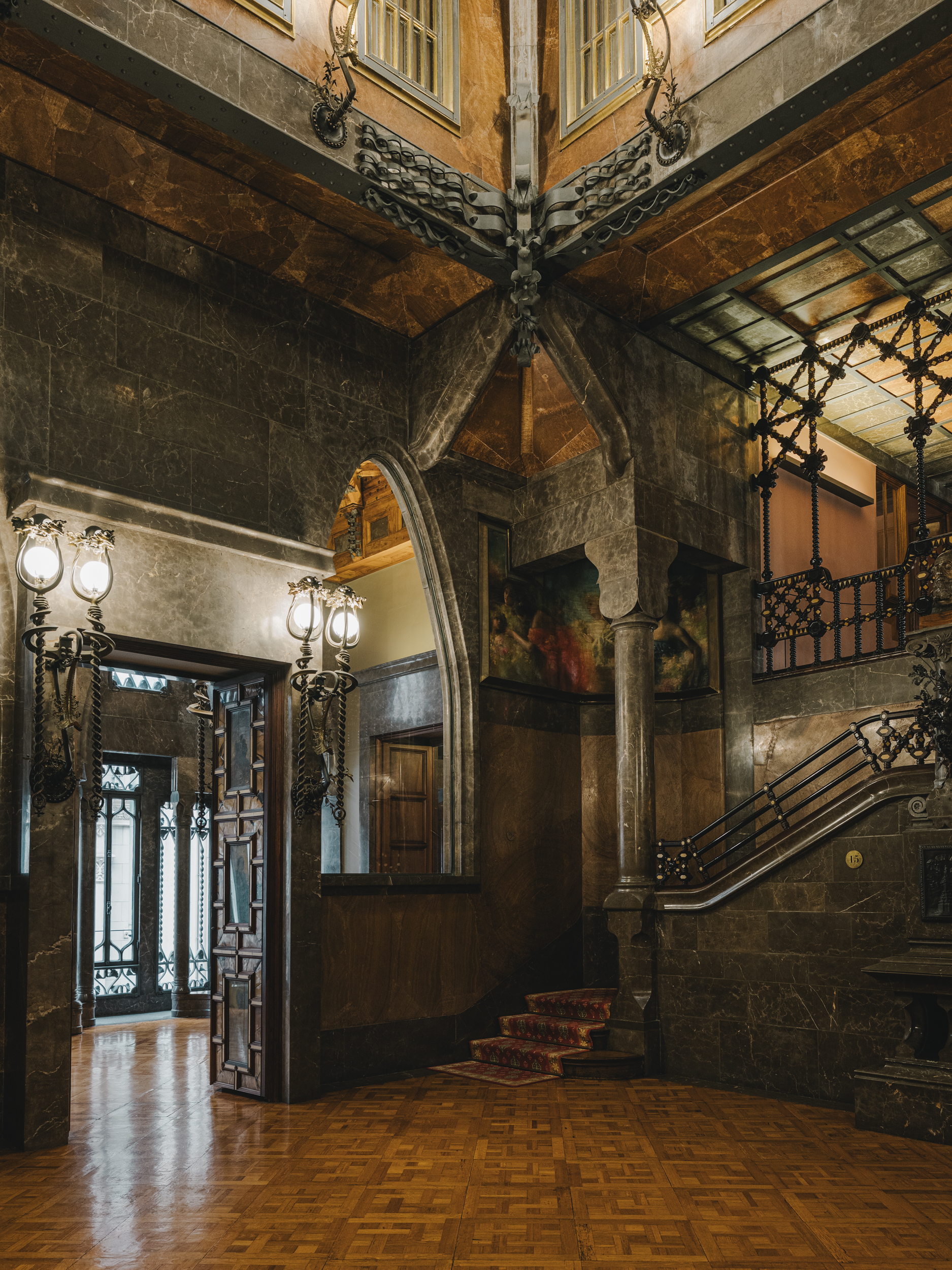
Due to the characteristics of the building, Palau Güell is not fully accessible to wheelchair users. However, there is an adapted route that provides access to the most important areas of the building: the noble floor, the main floor, the bedrooms and the attic. To follow this route, Palau Güell has a small lift (door width: 60 cm; interior dimensions: 78 cm deep by 83 cm wide).
Wheelchairs adapted to the dimensions of the lift are available for loan. If a visitor’s wheelchair exceeds the maximum dimensions of the lift, they will need to transfer to another wheelchair. Specialist visitor services staff can assist with the transfer. If continuous assistance is required throughout the visit, this must be requested in advance.
The areas that cannot be accessed by lift are the rooftop, mezzanine, stables and south-facing terrace. The stables, located in the basement, can only be reached via a 26-metre-long ramp with a 16% gradient.
There are seats and rest areas along the route.
Toilets:
There are accessible toilets on the ground floor.
The door is 77 cm wide. There is a fold-down grab rail to the left of the toilet and a fixed grab rail to the right.
There is clear space under the washbasin to allow a frontal approach.
The toilets also have baby-changing facilities.